
Management liability insurance is a category of insurance that addresses risks arising from the governance, management, and operation of an organization. It helps protect organizations and their directors, officers, and other insured individuals against specified financial losses. A claim against a director, an employment dispute, or employee theft can put an organization’s finances and, in some circumstances, the personal assets of its leaders at risk. This article explains the types of insurance commonly included under this term, how they relate, and what to consider when buying them separately or as part of a package policy.
About management liability
Management liability is a broad term used to describe the legal liabilities that can arise from the governance, management, and operation of an organization.
Organizations and their leaders have various legal duties and responsibilities. Actual or alleged failures to fulfil these responsibilities may result in claims or regulatory proceedings. For example, investors who lose money after leaders mislead them about the company’s finances may bring a claim against the organization and its leaders.
Organizations and their leaders may also face claims alleging wrongdoing when they believe they acted properly. Even when no wrongdoing or liability is established, defending those claims can be costly.
The possibility of facing these claims and having to pay legal defence costs, settlements, or judgments creates a financial risk for the organization and its leaders.
What is management liability insurance?
Management liability insurance is an umbrella term for several types of insurance designed to address financial risks associated with managing and operating an organization. Most of these coverages address legal liability arising from actual or alleged wrongful acts. The category also commonly includes commercial crime insurance, which primarily addresses direct financial losses resulting from specified criminal or fraudulent acts.
The different insurance policies it includes address related responsibilities, such as leading the organization, employing people, and overseeing employee benefit plans.
Considering these insurances together helps buyers and insurance professionals understand where one policy’s protection ends and another insurance need begins. For example, an organization buying D&O insurance may assume that it has comprehensive protection against employment-related claims. While some D&O policies provide a degree of employment practices liability coverage, others exclude or restrict it. A broker who understands both types of insurance can assess the protection already available and identify whether additional coverage is needed.
Both insurance professionals and their clients benefit from understanding how these insurances work together. This broader understanding helps insurance professionals make more complete recommendations and clients make informed decisions about their insurance protection.
Management liability insurance is all about the risks that arise from running an organization.
What does management liability insurance cover?
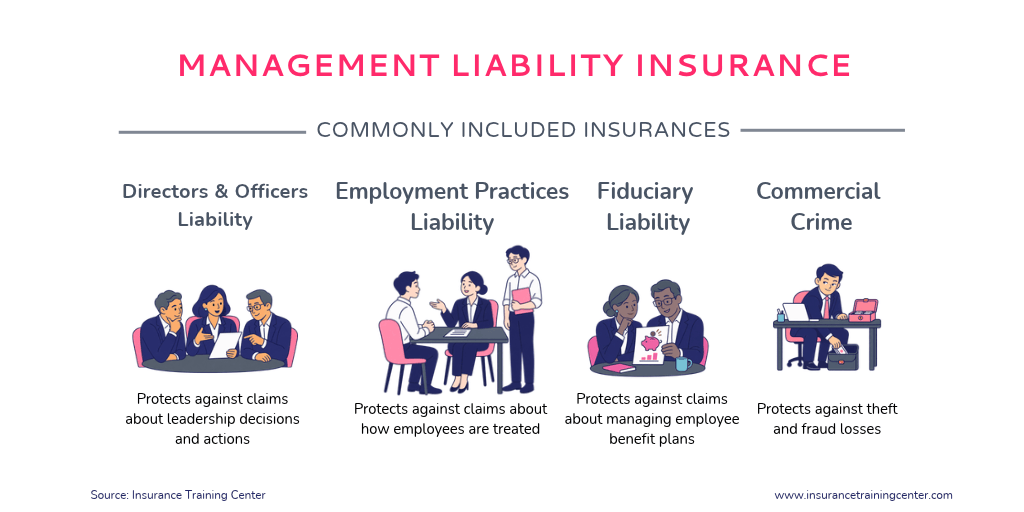
Management liability insurance commonly encompasses directors and officers (D&O) liability insurance, employment practices liability insurance (EPLI), fiduciary liability insurance, and commercial crime insurance.
There is no universal definition or standard management liability policy. The types of coverage available, and the extent of protection provided, vary by insurer, policy, jurisdiction, and type of organization. Buyers should not assume that a policy labelled management liability insurance includes all these coverages.
Directors and officers liability insurance
Directors and officers liability insurance, or D&O, helps protect directors, officers, and other insured individuals against claims alleging wrongful acts in their insured capacities. It can also reimburse an organization for amounts it pays to indemnify insured individuals and, depending on the policy, protect the organization against certain claims made directly against it.
The scope of organizational coverage varies considerably. For example, entity coverage under a public company D&O policy is commonly limited to securities claims, while private company and not-for-profit D&O policies may provide broader entity coverage. Investors might, for example, accuse directors of providing misleading financial information when raising capital. D&O insurance can help pay defence costs, settlements, and judgments arising from covered claims.
Employment practices liability insurance
Employment practices liability insurance, or EPLI, helps protect organizations and other insured parties against claims alleging wrongful employment practices, such as discrimination, harassment, retaliation, wrongful dismissal, and failure to hire or promote.
Claims may be brought by current employees, former employees, or job applicants. Some policies also provide coverage for certain third-party claims, such as allegations of discrimination or harassment brought by customers.
For example, an employee passed over for promotion might allege discrimination. Even if the employer believes its decision was fair, defending the claim can be costly.
Fiduciary liability insurance
Fiduciary liability insurance helps protect organizations, employee benefit plans, and insured individuals against certain claims arising from the management and administration of employee benefit plans, such as pension, retirement, and health benefit plans.
Individuals and organizations responsible for managing these plans may owe fiduciary duties to plan participants and beneficiaries. The nature of these duties and who qualifies as a fiduciary depend on the applicable laws and the responsibilities performed.
Fiduciary liability insurance may address claims alleging breaches of fiduciary duty and certain errors or omissions in plan administration. For example, pension plan members might allege that those responsible for managing the plan failed to adequately monitor investment fees.
Commercial crime insurance
Commercial crime insurance helps protect an organization against specified financial losses resulting from theft, fraud, and other covered criminal acts. Depending on the policy, coverage may include employee theft, forgery, computer fraud, funds transfer fraud, and social engineering fraud.
Unlike the liability coverages discussed above, commercial crime insurance is primarily a form of first-party insurance. It generally addresses direct losses suffered by the insured organization, rather than claims alleging that the organization or its leaders are legally liable to others.
For example, commercial crime insurance may cover company funds stolen by an employee. Some policies also provide coverage for specified losses involving client property.
How does management liability insurance work?
Management liability insurance helps reduce the financial impact of covered claims and losses arising from the management and operation of an organization.
When a claim or loss occurs, the insured reports it to the insurer in accordance with the policy’s requirements. The insurer assesses whether the claim or loss falls within the scope of coverage, taking into account the policy’s definitions, conditions, exclusions, and limits.
When does coverage apply?
Different types of management liability insurance operate on different coverage triggers. A coverage trigger helps determine which policy period may respond to a claim or loss.
- Claims-made coverage: D&O, employment practices liability, and fiduciary liability insurance are generally written on a claims-made or claims-made-and-reported basis. Coverage generally depends on when a claim is first made against an insured and whether it is reported within the time required by the policy. Other provisions, such as retroactive dates, prior acts restrictions, and prior knowledge exclusions, may also affect coverage.
- Discovery-based coverage: Under a discovery-based commercial crime policy, coverage generally depends on when a loss is discovered, subject to the policy’s terms and conditions.
- Loss-sustained coverage: Under a loss-sustained commercial crime policy, coverage generally depends on when the loss occurred and whether it was discovered within the period specified by the policy.
Understanding these differences is particularly important when purchasing, renewing, replacing, or cancelling insurance.
What does the insurer pay?
Depending on the type of insurance and the policy terms, management liability insurance may help pay for:
- Legal defence costs.
- Settlements and judgments.
- Certain investigation costs.
- Direct financial losses resulting from covered theft or fraud.
- Other expenses specifically covered by the policy.
The amount payable depends on the applicable coverage, policy limits, sublimits, and any retention or deductible.
Not all expenses or losses associated with an incident are necessarily covered. An incident may involve several types of insurance, each addressing a different aspect of the financial loss.
What does management liability insurance not cover?
Management liability insurance does not cover every risk associated with running an organization. Each type of insurance has its own scope of coverage and policy provisions.
A claim or loss may fall outside the scope of coverage or trigger a specific policy exclusion. Failure to meet a policy requirement, such as a reporting deadline, may also affect coverage.
There is no universal set of management liability insurance exclusions. The following table outlines common exclusions and coverage limitations that buyers should consider.
Common management liability insurance exclusions and limitations
| Exclusion or limitation | What buyers should know |
|---|---|
| Fraud, dishonesty, and illegal personal profit | Liability policies commonly exclude certain dishonest or fraudulent conduct and improperly obtained personal benefits. An allegation of fraud does not automatically eliminate coverage. See How do fraud and dishonesty exclusions work? below. |
| Prior or pending claims and litigation | Liability policies may exclude claims arising from litigation or proceedings that began before a specified date. |
| Previously known claims or circumstances | Liability policies may restrict coverage for claims or circumstances that an insured knew about before obtaining coverage. This does not mean that the policy excludes all wrongful acts that occurred before its inception. |
| Bodily injury and property damage | Management liability policies commonly exclude liability claims involving bodily injury or property damage, although exceptions may apply. Commercial general liability insurance addresses many of these exposures. |
| Professional services | Management liability policies may exclude claims arising from the delivery of professional services. Professional liability insurance addresses many of these risks. |
| Contractual liability | Liability policies may exclude certain obligations or liabilities arising from contracts. The scope of the exclusion and its exceptions vary by policy. |
| Insured versus insured claims | D&O insurance may exclude certain claims that one insured brings against another. Policies often contain exceptions to this exclusion. |
| Wage and hour disputes | Employment practices liability insurance may exclude or restrict coverage for claims involving unpaid wages, overtime, or employee classification. Some policies offer limited defence costs coverage. |
| Employee benefit obligations | Fiduciary liability insurance generally does not cover benefits or contributions that an organization or benefit plan already has a legal obligation to pay. |
| Fines and penalties | Policy provisions and applicable laws may restrict coverage for fines and penalties. Some policies cover specified fines or penalties where the law permits insurance. |
| Cyber incidents | Management liability policies may exclude or restrict certain cyber-related claims or losses. However, D&O insurance may cover claims against directors or officers arising from their alleged failure to manage cyber risks. Crime insurance may cover certain computer fraud losses. Uncertainty about whether traditional insurance policies cover cyber-related losses can create silent cyber exposure. |
| Commercial crime losses | Commercial crime insurance covers specified types of loss. Policies may exclude trading losses or inventory shortages that the insured cannot substantiate without relying solely on an inventory calculation. Policies also commonly restrict coverage for indirect financial losses and certain types of fraud. |
How do fraud and dishonesty exclusions work?
An allegation of fraud or dishonesty does not automatically eliminate coverage under a management liability policy.
Some liability policies require a final adjudication or another specified determination before a conduct exclusion applies. Depending on the policy wording, the insurer may pay or advance defence costs while the allegations remain unresolved.
Some policies also contain severability or non-imputation provisions. These provisions may preserve coverage for other insured individuals who did not participate in or have knowledge of the misconduct.
Buyers should distinguish between liability insurance and crime insurance. D&O insurance may exclude claims involving certain established dishonest conduct by an insured. In contrast, commercial crime insurance specifically addresses certain financial losses resulting from theft or fraud.
What other types of insurance may be needed?
Management liability insurance forms part of a broader commercial insurance program. Depending on the organization’s activities and exposures, it may need additional types of insurance.
- Commercial general liability insurance (CGL): Covers certain third-party claims involving bodily injury or property damage.
- Professional liability insurance (E&O): Covers certain claims arising from errors or omissions in the delivery of professional services.
- Cyber insurance: Covers specified financial losses and third-party liabilities arising from cyber incidents.
- Commercial property insurance: Covers physical loss of or damage to insured property resulting from covered events.
- Business interruption insurance: Covers specified financial losses resulting from interruptions to business operations that meet the policy’s coverage requirements.
Some insurers offer additional coverages within specialized management liability packages. Organizations can also purchase them separately.
Rather than reviewing each policy in isolation, organizations and their insurance advisers should consider how the policies work together. This helps identify gaps and potential overlaps in coverage.
For definitions of related insurance terms, consult our insurance glossary.
One incident, several insurance questions
Consider a fictional company that discovers its finance manager has stolen company funds by submitting false invoices.
The company dismisses the manager and investigates the loss. During the investigation, a former employee says she raised concerns about the invoices and was dismissed shortly afterwards. She brings a claim alleging retaliation. Investors also bring a claim against the directors, alleging that they ignored warning signs and failed to oversee the company’s finances.
The theft has led to three distinct insurance issues:
| Loss or allegation | Insurance to examine |
|---|---|
| The company has lost money through employee theft | Commercial crime |
| A former employee alleges dismissal in retaliation for reporting concerns | Employment practices liability |
| Investors allege failures by the directors | D&O liability |
The crime policy might address the stolen money. EPLI and D&O might address the separate claims involving the employee’s dismissal and the directors’ alleged failures. Whether each policy responds depends on the facts and its terms.
When a single incident gives rise to multiple claims or losses, it is important to identify all potentially applicable coverages and ensure that the reporting requirements for each are met. How these claims and losses are reported and coordinated may depend on whether the coverages were purchased as standalone policies or as part of a package policy. See Claims handling and notification below.
A professional specializing in EPLI may recognize the retaliation claim. Understanding the wider management liability area also helps them identify the theft loss and the claim against the directors, then involve the appropriate specialists.
Buying management liability insurance
Organizations can buy management liability coverages through standalone policies, potentially from different insurers, or through a management liability package.
A package policy may allow buyers to select multiple coverage sections within a single insurance contract. Some insurers also offer coordinated insurance programs consisting of separate policies. Depending on the insurer, additional coverages, such as cyber insurance or kidnap and ransom insurance, may be available.
Insurers also design packages for particular industries. An asset management firm, for example, may be able to combine professional liability insurance for its investment services with D&O, employment practices liability, and fiduciary liability insurance.
The choice depends on the organization’s activities, the protection available, and the terms and cost of each option.
Cost and administration
- A package policy can simplify the purchase and administration of multiple coverages and may offer premium savings.
- Standalone policies allow buyers to select insurers, coverage terms, limits, and retentions independently. This may involve more administration but can provide access to more competitive pricing or broader coverage for particular risks.
- Buyers should compare the overall cost and quality of protection rather than assuming one arrangement is less expensive than the other.
Policy limits
- Package policies may provide separate limits for each coverage section, a shared limit across multiple sections, or a combination of both. Where limits are shared, payments under one section can reduce the amount available under another. For example, payments for an employment practices liability claim could reduce the amount available for a subsequent D&O claim. Some coverage sections may also be subject to sublimits.
- Standalone policies generally provide independent limits for each type of insurance. Payments under an EPLI policy, for example, would not normally reduce the limit available under a separate D&O policy.
Regardless of the arrangement, buyers should determine whether defence costs are payable within or in addition to the applicable liability limits. When defence costs are included within the limit, legal expenses reduce the amount available to pay settlements or judgments.
Buyers should assess not only the adequacy of the individual limits but also how those limits interact and whether sufficient coverage would remain available if the organization faced multiple claims or losses during the same policy period.
Claims handling and notification
Notification requirements
- A package policy may simplify notification by providing a single point of contact for reporting claims and losses. However, the insured must still ensure that the notification requirements of each potentially applicable coverage section are met.
- Standalone policies may require separate notifications, particularly when coverage is purchased from different insurers. Each policy may have different reporting requirements and deadlines.
- Failure to comply with a policy’s notification requirements may jeopardize coverage.
Claims coordination
- A package policy may simplify claims handling by allowing one insurer to coordinate investigations, defence arrangements, and coverage assessments across multiple coverage sections.
- Standalone policies may provide access to different insurers’ specialist claims expertise. However, when an incident involves multiple policies, insurers may need to coordinate their claims handling. Where coverage overlaps, insurers may also need to determine how to allocate defence costs, settlements, or other covered amounts between policies.
- Having one insurer does not necessarily eliminate coverage disputes, as each coverage section has its own terms, conditions, and exclusions.
Defence arrangements
Management liability policies differ in how they address the defence of liability claims. Some policies impose a duty to defend on the insurer, while others require the insured to arrange its own defence, subject to the policy’s terms and conditions.
Regardless of whether coverage is purchased through a package or standalone policies, buyers should understand:
- Whether the insurer has a duty to defend or an obligation to advance or reimburse covered defence costs.
- Who selects and appoints legal counsel.
- Who controls the defence and settlement of a claim.
- When the insurer’s consent is required before incurring defence costs or agreeing to a settlement.
These provisions can affect how a claim is managed, the insured’s involvement in the defence, and its financial obligations during the claims process.
Organization size and sector
- Smaller organizations with limited administrative resources may find a suitable package convenient.
- Larger or more complex organizations may need tailored terms, higher limits, or several insurers.
Size alone does not determine the best arrangement. A small firm can have significant specialist risks, while an industry-specific package may suit a complex organization. Consider the organization’s activities, ownership, workforce, benefit plans, and financial controls.
Changing needs
- A package may allow insurance to be added or adjusted, subject to the insurer’s agreement.
- Standalone policies may give buyers greater flexibility to replace or expand individual coverages. However, changing insurers or policy terms requires careful attention to continuity of coverage, prior acts protection, exclusions, and reporting requirements, particularly for claims-made policies.
Revisit the arrangement when the organization changes, for example, when it acquires another business, raises capital, expands its workforce, or introduces a benefit plan.
Before choosing, confirm who is insured, which claims or losses are covered, what is excluded, and what the organization must pay itself. An organization can also combine approaches, such as buying a management liability package and a separate cyber policy.
Frequently asked questions about management liability insurance
Is management liability insurance the same as D&O insurance?
No. Directors and officers (D&O) liability insurance is one type of management liability insurance. Management liability insurance is a broader category that may also include employment practices liability, fiduciary liability, and commercial crime insurance.
Insurers use the term differently. Buyers should review the individual coverages rather than rely on the policy name alone.
Who needs management liability insurance?
Any organization with management responsibilities may face management liability risks. This includes privately held businesses, publicly traded companies, and not-for-profit organizations.
Small businesses are not immune to these risks. Even a business with few employees can face employment disputes or allegations of management misconduct.
The types of insurance an organization needs depend on its exposures and legal responsibilities.
Do not-for-profit organizations need management liability insurance?
Yes, not-for-profit organizations should consider management liability insurance. Board members, including volunteers, may face personal liability for breaches of their legal duties.
These organizations may also face employment-related claims or financial losses resulting from theft and fraud.
Some insurers offer management liability packages specifically designed for not-for-profit organizations.
How much does management liability insurance cost?
The cost of management liability insurance depends on the organization’s risk profile and the coverage it purchases. Factors that may influence the premium include:
- Organization size and revenue.
- Financial condition.
- Industry and business activities.
- Ownership structure.
- Number of employees.
- Claims history.
- Coverage limits and retentions.
- Risk management practices.
The cost also depends on whether the organization purchases standalone policies or a management liability package.
Is management liability insurance mandatory?
There is no universal legal requirement to purchase management liability insurance. However, certain jurisdictions or industries may require specific types of coverage.
Investors or lenders may also impose insurance requirements as a condition of their agreements. Organizations should review their legal and contractual obligations.
What is the difference between management liability and professional liability insurance?
Management liability insurance addresses risks associated with the governance and management of an organization. Professional liability insurance addresses certain claims arising from the delivery of professional services.
For example, a shareholder may sue a director for mismanaging company funds. This claim may fall under D&O insurance. A client who suffers a financial loss because of incorrect professional advice may bring a claim that falls under professional liability insurance.
An organization may need both types of insurance.
Can directors and officers be held personally liable?
Yes. Depending on applicable laws, directors and officers may face personal liability for breaches of their legal duties.
An organization may indemnify its directors and officers. However, legal restrictions or financial difficulties may prevent it from doing so.
D&O insurance can help protect the personal assets of insured directors and officers against covered claims.
How much management liability insurance does an organization need?
There is no standard insurance limit that suits every organization. Buyers should assess the potential financial impact of claims and losses. They should also consider the cost of defending liability claims and any contractual insurance requirements.
When purchasing a management liability package, buyers should determine whether the individual coverages share a policy limit. A claim under one coverage could reduce the insurance available to respond to another claim.
Build your management liability expertise with CMLIP™
Understanding individual policies is essential. Connecting them to a client’s wider needs makes that knowledge more valuable.
“A management liability specialist develops expertise across the different policies, helping them identify client needs, explain the protection available, and recognize which policies to examine when a claim or loss occurs.”
ITC’s Certified Management Liability Insurance Professional (CMLIP™) program develops knowledge across D&O, employment practices liability, fiduciary liability, crime, and related types of insurance. It combines insurance education with financial analysis and professional skills, followed by a capstone case study and final examination.
Build the knowledge to recognize more client needs, explain insurance clearly, and make informed recommendations.