
Many people don’t set out to build a career in insurance. They may apply for an entry-level position at an insurance company or brokerage, accept a summer internship, or transition from another industry—and discover a profession that offers long-term career opportunities, continuous learning, and a surprising variety of roles.
Whether you’re still in school, recently graduated, changing careers, or simply exploring your options, the insurance industry offers opportunities for people with many different skills and interests.
This guide explains how the insurance industry works, the types of careers available, and the practical steps you can take to land your first insurance job.
7 Steps to Get Started in the Insurance Industry
There is no single path into insurance. Some people enter the industry immediately after completing their education, while others bring experience from banking, retail, hospitality, construction, finance, healthcare, technology, or another profession.
The following steps will help you understand the industry, explore career options, and prepare for your first insurance role.
Step 1: Learn what the insurance industry does
Before deciding whether insurance is the right career for you, it’s helpful to understand what the industry actually does.
Insurance helps individuals and businesses recover financially after unexpected events such as car accidents, house fires, lawsuits, workplace injuries, cyber attacks, and natural disasters. By spreading risk across many policyholders, insurers provide financial protection when covered losses occur.
Behind every insurance policy is a team of professionals. Some help customers choose the right coverage, others evaluate risk, investigate claims, develop new insurance products, analyze data, ensure regulatory compliance, or support the technology that keeps the business running.
You don’t need to become an expert before applying for your first job, but understanding the basics will help you make informed career decisions and prepare you for interviews.
New to insurance?
If you’d like a deeper understanding of how the insurance industry works, ITC’s upcoming Navigating the Insurance Ecosystem course will demystify this complex network, explaining how the industry evolved, the different types of organizations involved, how the risk transfer and claims process works, and what it’s like to work in the industry.
Want a deeper introduction? ITC’s upcoming Insurance Industry Fundamentals course provides an overview of how the insurance industry works, the organizations involved, common insurance products, and the many career opportunities available throughout the industry.
Step 2: Explore different types of insurance careers
When most people think about insurance, they picture someone selling insurance policies. In reality, selling insurance is just one part of the industry. Insurance companies, brokerages, reinsurers, and other insurance organizations employ professionals in a wide range of roles.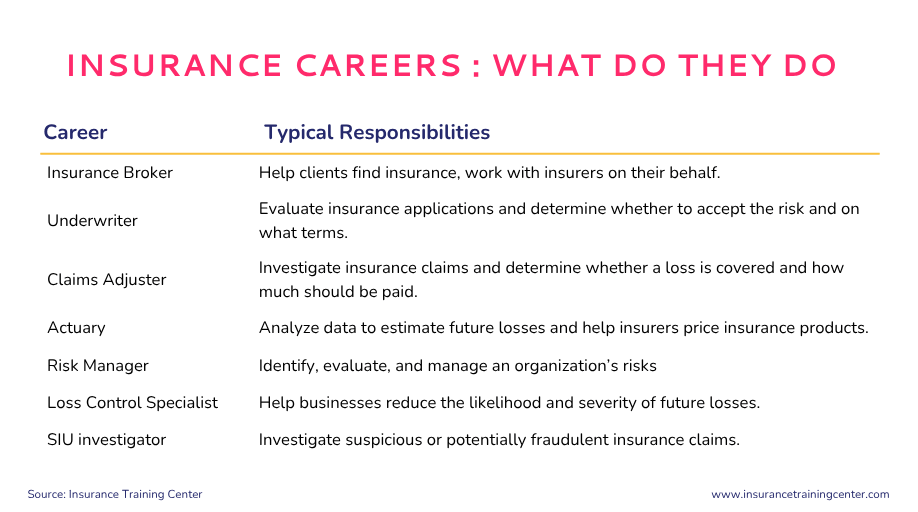
Insurance organizations also employ professionals in finance, marketing, human resources, legal and compliance, information technology, cybersecurity, data analytics, and many other business functions.
Related articles:
Step 3: Match your skills and interests to insurance careers
If you don’t know which insurance career is right for you, start by thinking about the type of work you enjoy—not the job title. Insurance companies need people with many different strengths.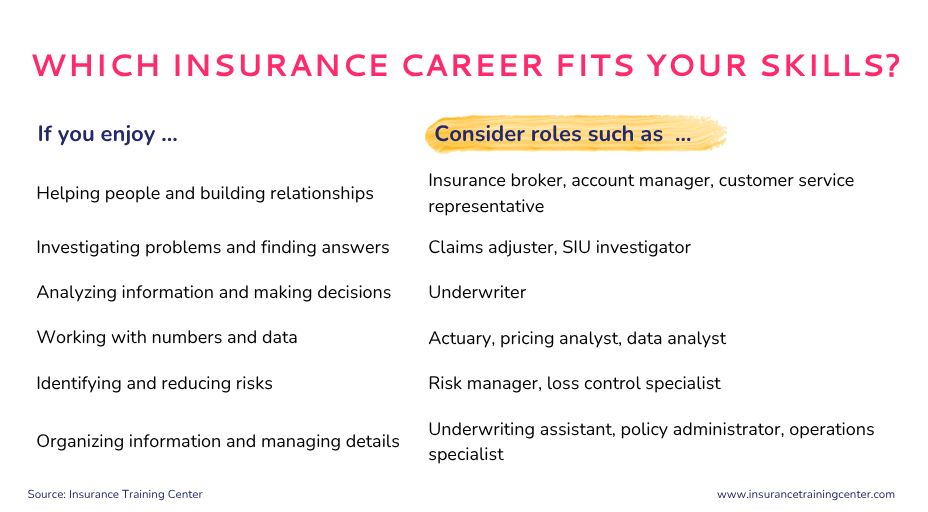
For example, if you enjoy helping people and building relationships, you may be well suited to a career as an insurance broker, account manager, or customer service representative. If you like investigating problems and finding answers, claims adjusting or special investigations may be a good fit. People who enjoy analyzing information and making decisions may find underwriting a good fit. Those who prefer working with numbers and data may be interested in actuarial, pricing or data analysis roles.
If you’re interested in identifying and reducing risks, consider risk management or loss control. If you’re highly organized and enjoy managing details, role such as underwriting assistant, policy administrator, or insurance operations may be a good match.
Remember, your first insurance job doesn’t have to be your last.
Many insurance professionals build successful careers by working in several different roles. In fact, that experience often makes them more effective.
For example, a commercial insurance broker who previously worked as an underwriter understands how insurers evaluate risk, price policies, and make underwriting decisions. Because brokers work between clients and insurance companies, that knowledge can help them present risks more effectively, negotiate coverage, and provide better advice to their clients.
Similarly, someone who has worked in claims may become a stronger underwriter because they’ve seen firsthand how and why losses occur.
Rather than trying to choose the “perfect” career from day one, focus on finding a role that gives you a solid understanding of the industry and opportunities to learn.
Step 4: Find out if you’ll need a licence
Some insurance careers require a licence before you can legally perform certain job duties, while others do not.
For example, insurance brokers, insurance agents, and claims adjusters often need to be licensed. In contrast, many underwriters, actuaries, analysts, administrators, accountants, marketing professionals, and technology specialists work in insurance without holding a licence.
A licence is issued by an insurance regulator or licensing authority and gives you legal permission to perform certain regulated insurance activities.
How do you get an insurance licence?
The process varies depending on where you live and the type of insurance work you want to do, but it typically involves:
-
- Completing an approved licensing course or training program.
- Passing a licensing examination.
- Applying to the appropriate insurance regulator or licensing authority.
- Meeting any additional requirements, such as a background check or sponsorship by an employer, where applicable.
Some employers hire candidates first and then help them complete the licensing process. Others expect applicants to be licensed before they begin work.
Always check the licensing requirements in the jurisdiction where you plan to work.
Step 5: Build knowledge that employers value
Most employers don’t expect entry-level candidates to know everything about insurance.
They do, however, value candidates who demonstrate curiosity, professionalism, and a willingness to learn.
Taking an introductory insurance course before applying for jobs can help you understand industry terminology, build confidence for interviews, and show employers that you’re serious about a career in insurance.
You can also strengthen your qualifications through professional education, including industry certifications and professional designations. While these educational credentials are generally optional, they demonstrate specialized knowledge and a commitment to continuous learning.
Employers also look for transferable skills such as:
-
- Communication
- Customer service
- Problem solving
- Attention to detail
- Organization
- Analytical thinking
- Professional writing
- Time management
If you’ve worked in retail, hospitality, banking, healthcare, construction, finance, technology, or another customer-focused industry, you may already have many of the skills insurance employers value.
Step 6: Start looking for opportunities
There are many ways to enter the insurance industry, depending on where you are in your education or career.
If you’re still in school
Many insurance companies, brokerages, and other insurance organizations recruit students through:
-
- Internships
- Co-operative education (co-op) programs
- Work placements
- Summer or vacation employment
- Graduate or trainee programs
If your school has a career centre or employment office, ask whether it works with insurance employers or hosts career fairs where insurance companies recruit students.
If you’ve recently completed your education
Many larger insurance organizations offer graduate or trainee programs that provide structured training and exposure to different parts of the business before participants move into permanent roles.
If these programs aren’t available where you live, don’t overlook entry-level positions. Many successful insurance professionals begin in customer service, administration, underwriting support, or claims support before moving into more specialized roles.
If you’re changing careers
Insurance employers regularly hire people with experience in other industries.
Backgrounds in banking, finance, retail, hospitality, healthcare, construction, law, customer service, and technology often translate well because employers value communication, analytical thinking, project management, relationship-building, and problem-solving skills.
Where to look
Search for opportunities on:
-
- Insurance company career pages
- Insurance brokerage career pages
- Reinsurance company career pages
- LinkedIn Jobs
- General job boards
- Industry association job boards
Common entry-level job titles include:
-
- Customer Service Representative
- Broker Assistant
- Insurance Advisor
- Underwriting Assistant
- Claims Assistant
- Claims Representative
- Insurance Administrator
- Policy Services Representative
- Account Coordinator
Don’t be discouraged if your first job isn’t your dream role. The experience you gain early in your career can open the door to many different opportunities later on.
Step 7: Make yourself a strong candidate
Insurance employers often hire for potential as much as experience.
Tailor your résumé to each position and emphasize the skills you’ve developed through previous jobs, volunteer work, education, or extracurricular activities.
During interviews, demonstrate that you’ve taken the time to learn about the industry and explain why you’re interested in building a career in insurance.
If you’ve completed an introductory insurance course, earned a certification, or started working toward a professional designation, be sure to include it on your résumé and discuss it during the interview.
Remember, employers aren’t necessarily looking for someone who already knows everything about insurance. They’re looking for someone who is motivated to learn, communicates well, pays attention to detail, and is ready to contribute.
Frequently Asked Questions
Do I need a degree to work in insurance?
No. Insurance employers hire people with many different educational backgrounds, and some roles do not require a degree. Depending on the position, employers may value relevant work experience, transferable skills, professional training, or industry licences as much as formal education.
Is insurance a good career?
For many people, yes. Insurance offers career stability, opportunities for advancement, competitive compensation, and a wide variety of career paths. It’s also an industry where learning new skills can lead to specialization and leadership opportunities.
Is it difficult to get into the insurance industry?
Generally, no. Many employers hire candidates with transferable skills and provide training for entry-level positions. Demonstrating an interest in the industry and a willingness to learn can help you stand out from other applicants.
What’s the best entry-level insurance job?
There isn’t a single “best” entry-level job. Customer service, underwriting assistant, claims assistant, broker assistant, and administrative roles all provide valuable experience and can lead to many different career paths.
Can I move into different roles later?
Absolutely. Many insurance professionals work in several different roles throughout their careers. Moving between claims, underwriting, brokerage, risk management, and other areas can broaden your knowledge and create new career opportunities.
Remember this!
The insurance industry offers far more career opportunities than many people realize. Whether you enjoy helping people, analyzing information, solving problems, working with numbers, or building relationships, there’s likely a role that matches your interests and strengths.
You don’t need to have your entire career mapped out before applying for your first insurance job. Start by learning how the industry works, explore the different careers available, build your knowledge, and look for opportunities to gain experience. Your first role is just the beginning, and the skills and relationships you develop can lead to a rewarding career with many different paths forward.